AI Workflow Automation as an Operations Layer for Commercial Cleaning
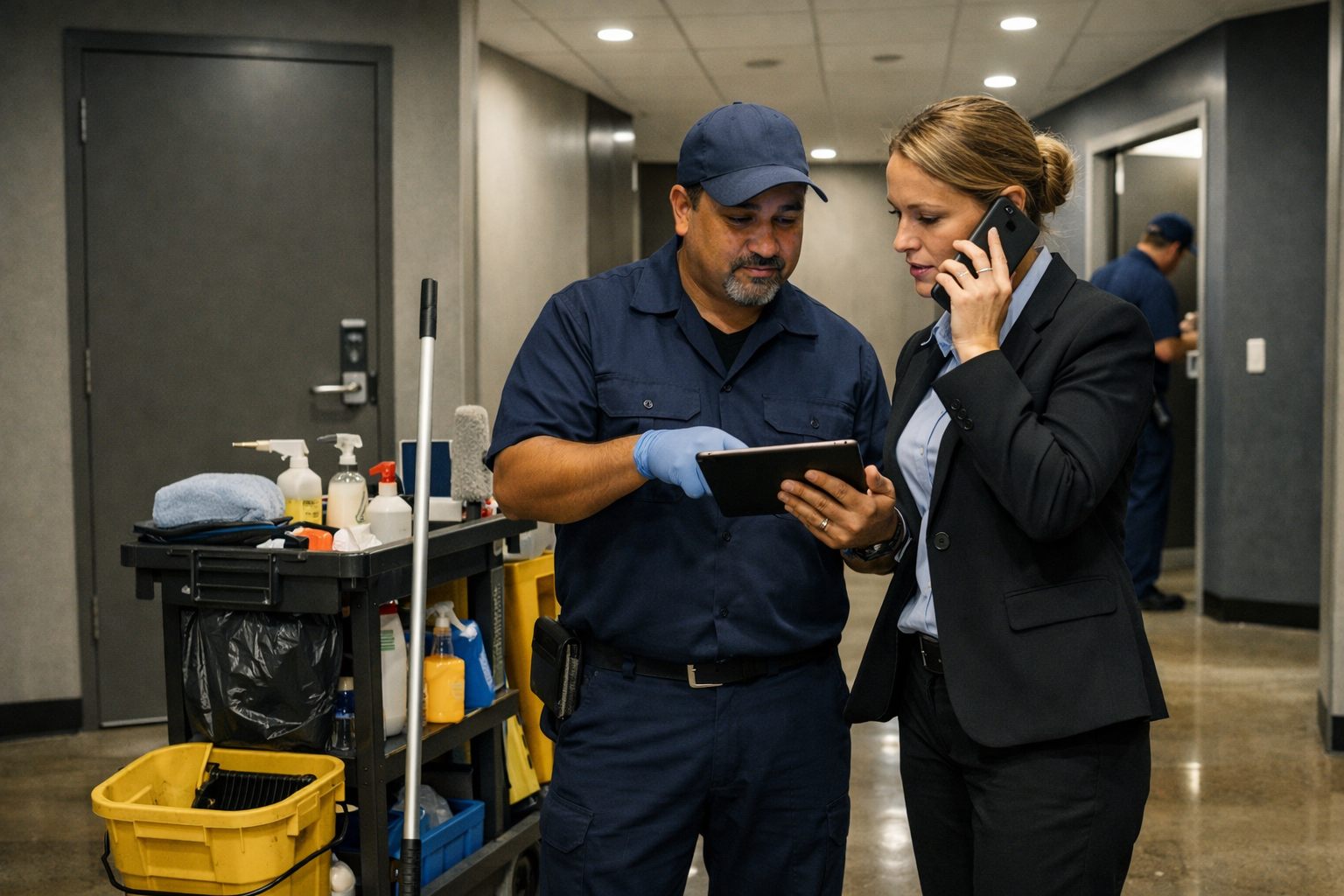
When a nightly crew flags a locked supply closet or an incomplete restroom check, the important checkpoint is whether that detail reaches the account owner, supervisor, and billing record in time to act. AI workflow automation captures information from emails, forms, calls, and completion records; classifies the event; drafts a context-aware update; triggers an approved next step; and highlights exceptions that need attention. The objective is fewer missed handoffs and more consistent service execution, not generic AI activity.
Commercial cleaning workflow automation differs from dispatch-first field-service software. Dispatch tools primarily assign people and route work. This approach follows the recurring contract: the site-specific scope, checklist and proof of completion, inspection result, client communication, approved extra work, and billing record. A nightly crew may be scheduled correctly yet still create an account risk if a failed restroom check, access problem, or client request remains isolated in someone’s inbox.
- A proposal sent can trigger a follow-up draft and task; a sales or account leader approves any client commitment.
- A completed checklist can update the service record; a supervisor reviews missing items, photos, and quality exceptions.
- A client complaint can be routed with site and scope context; an accountable manager decides the remedy and response.
- A billing-period close can assemble service and exception records; finance approves pricing changes and the final invoice.
This is AI automation for service businesses applied where cleaning operations most often lose continuity: from bid follow-up through recurring delivery, issue resolution, account communication, and invoicing coordination. Supervisors still inspect, relationship owners still manage sensitive conversations, and finance still controls financial approval; automation makes the next approved action visible and timely.
Choose the First Cleaning Workflows to Automate by Frequency, Risk, and Handoff Complexity
Rank workflows by the operational leakage they create: score each one from 1 to 5 for monthly frequency, revenue or retention exposure, number of role or system handoffs, and cost when follow-up is late. A nightly checklist exception that crosses a crew lead, supervisor, account manager, and client contact should outrank a rare process that depends on negotiation or individual judgment.
Map the workflow before automating it: define the trigger that starts work, the inputs such as site, scope, contact, photos, or service records, the automated action, the human decision point, the system handoff, and the measurable result. For example, a proposal sent can trigger a timed follow-up draft using the prospect’s site and requested scope; the sales lead approves the message; the CRM receives the activity record; follow-up completion and bid response time are the measures.
- Strong first candidates have structured inputs and a visible next step: a signed recurring contract can create onboarding tasks for the site profile, scope, contacts, start date, and checklist; a missed-service form can assemble the shift details and assign a supervisor review.
- Supply requests, inspection-summary drafts, routine client-update drafts, and invoice-support packets are similarly practical because they turn repeatable records, requested items, inspection notes, completion evidence, and approved changes, into a routed task or prepared record. Track checklist completion, missed-service resolution time, client-update consistency, and invoice-readiness lag.
- Keep disputed scope, disciplinary decisions, and complaints with missing site or scope-of-work details human-led at first. These processes are exception-heavy: ownership and the facts needed to route the case are unclear, so AI operations automation for cleaning companies should not infer a remedy or commitment.
Use AI to Strengthen Bid Follow-Up and Move Won Contracts Into Operations
The bid record should become the first operating record for a new account, rather than a set of emails and notes that must be reconstructed after the sale. This workflow begins when a proposal is sent, a prospect replies, requests a revision, gives verbal acceptance, or signs an agreement. Each status change can create a visible next step and reduce the handoffs that otherwise leave bids inactive or onboarding incomplete.

A walkthrough summary can turn free-form notes, photos, and meeting details into a reviewable account brief: spaces included, cleaning frequency, requested tasks, exclusions, access instructions, decision-makers, and open questions. AI can identify questions the proposal did not answer and prepare account-specific automated customer follow-ups, such as a message requesting floor-care frequency or clarifying who provides consumables. The salesperson approves final pricing, scope commitments, and relationship-sensitive proposal language before anything is sent.
- After a proposal is sent, a timed workflow can draft a follow-up and prompt the assigned salesperson when no response is recorded. A prospect reply can be summarized, categorized as a question or revision request, and attached to the bid record.
- After verbal acceptance or signature, the workflow can prepare a structured handoff packet for operations: site addresses, service days and frequencies, scope and exclusions, access and alarm details, site contacts, escalation expectations, and promised service-level commitments. An account leader reviews the packet for omissions before it becomes the starting record for recurring service.
Measure bid response time and follow-up completion on the sales side, then track whether operations receives a complete handoff on the service side. The practical result is fewer stale bids, less rework to locate walkthrough details, and a clearer basis for setting up the account correctly.
Coordinate Recurring Service Delivery With Site-Specific Checklists and Completion Signals
Each recurring visit should begin with the context needed to perform that site’s contracted work, not a generic task list. When a scheduled service event is due, the workflow can assemble the approved scope, current client notes, secure-area access instructions, periodic work such as monthly floor care, prior inspection findings, and expected consumables into a crew-ready checklist. This helps automate commercial cleaning operations around the service event itself rather than treating recurring janitorial services as a routing problem.
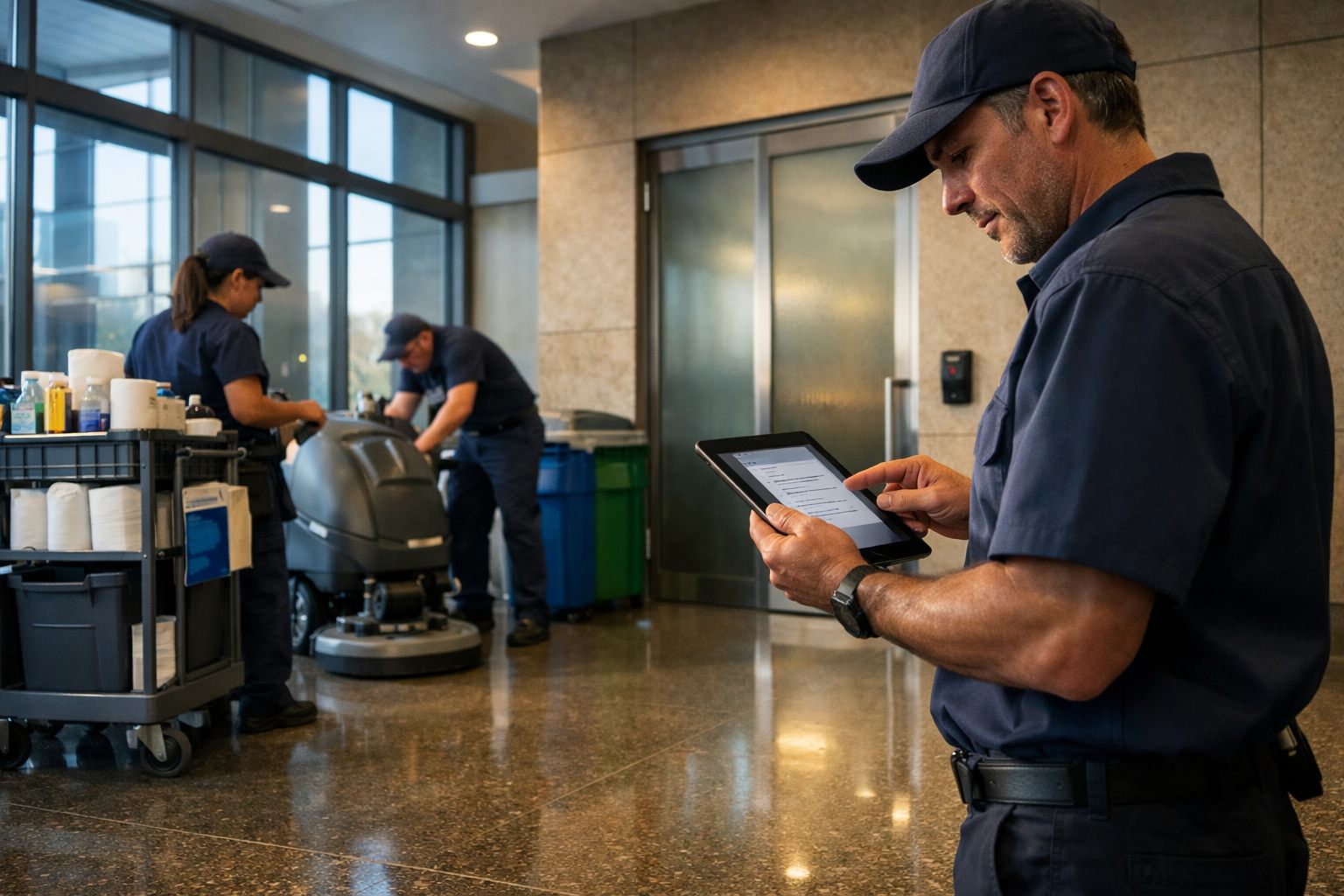
- The crew lead receives a simple mobile form with required and optional fields. Required fields create a usable completion signal, checklist status, arrival and completion timestamps, and an exception selection, while optional notes and photos add context for conditions that cannot be captured by a checkbox.
- A restroom consumables request, a photo of a blocked area, or a note that an alarm code failed can be attached to the same service record. AI can organize these entries, summarize long comments, identify missing required fields, and flag language that may indicate an unusual condition or incomplete work.
- The system handoff is a routed follow-up for the site supervisor: replenish supplies, clarify access, review a quality concern, or contact the appropriate account owner. Routine, complete records can remain available for review without creating an unnecessary manual queue.
Completion documentation is not quality control. A supervisor still reviews evidence, inspects when warranted, coaches the crew lead, and decides whether the issue requires remediation. Track checklist completion, records with missing fields, and time from exception submission to supervisor action; those measures show whether the workflow is producing consistent service records and fewer missed handoffs.
Escalate Missed Service and Quality Issues Before They Become Account Risks
An unresolved complaint can turn a single missed service into an account-retention problem when the office, supervisor, and client each hold different pieces of the story. Commercial cleaning business automation can intake emails, texts, client forms, and inspection notes; classify the issue; match it to the account and site; and assemble the relevant scope, recent completion records, prior exceptions, and open work orders into one reviewable case.
- Routine service question: A request for supplies or clarification on a completed task goes to the site supervisor, who can answer it or create a remediation task without involving the account team.
- Account-risk issue: A client complaint, failed inspection, or repeated missed service creates or updates a work order for the supervisor and alerts the account manager. For example, the workflow can draft a same-day acknowledgment to the client while assigning the supervisor a remediation task with the complaint details, site history, and required follow-up.
- Higher-sensitivity exception: Damage reports and safety-related concerns route to designated leadership, while work requested outside the contracted scope enters a review path for a possible change order rather than being silently added to the crew’s duties.
Classification determines the next owner, not the final decision. AI may summarize inspection comments and draft a factual client update, but a responsible manager approves remediation commitments, service credits, revised scope, and liability-sensitive language. Closure should record the work completed, supervisor review, client communication, and any contract decision. Track missed-service resolution time, repeat issues by site, and on-time client acknowledgments to expose handoffs that still put accounts at risk.
Coordinate Invoicing With Service Records, Exceptions, and Contract Changes
Billing should begin with a reviewable service record, not a search through emails after month-end. For recurring contracts, the billing-period close can create an invoice-readiness packet for finance: contracted rate and frequency, completed service forms, relevant inspection outcomes, and any open work order tied to that site.

- Regular contract billing: Match the scheduled services and agreed contract terms to the period being billed. Missing completion fields become a flag for operations, not an automatic reason to alter a charge.
- Approved extra service: When an authorized add-on is completed, attach the approval, work order, completion evidence, and agreed price so the reviewer can determine whether it belongs on the invoice.
- Signed change order: A changed scope updates the billing packet from its effective date forward, separating the revised recurring charge from one-time work.
- Unresolved exception: A complaint, failed inspection, or remediation task places the affected service in an exception queue. Finance sees the context, while the accountable manager decides whether to bill as planned, delay the item, or issue a credit.
Automated invoicing for service businesses is most useful here as coordination and documentation readiness. AI can summarize the records, identify missing approvals or unsupported add-ons, and route an invoice-ready summary to the designated finance reviewer. It should not decide charges, approve credits, release invoices, or authorize financial transactions. Track invoice-readiness lag, records returned for missing evidence, and disputes tied to billed work; those measures reveal whether operations and finance are maintaining a clean audit trail.
Implement AI Automation With Clean Data, Clear Ownership, and Measurable Service Outcomes
Build the pilot on a shared operating record, not scattered inboxes and spreadsheets. At minimum, standardize the client and site record, decision-maker and billing contacts, scope of work, service frequency, SLA rules, inspection criteria, escalation owner, contract terms, service history, and the systems where scheduling, communications, work orders, and accounting records reside.
Choose one high-volume workflow with stable inputs, for example, proposal follow-up or incomplete completion-form routing, and run it with the people who already own the work. The workflow owner is accountable for its result; the reviewer approves outputs that cross a defined threshold, such as a client-facing commitment, scope change, credit request, or invoice release. Record those thresholds before launch, then refine prompts, required fields, and routing rules from real exceptions rather than expanding an unreliable process.
- Sales follow-through: measure bid-response time and stale-proposal rate.
- Service consistency: measure completion-documentation rate and records returned for missing information.
- Issue management: measure acknowledgment time and time to resolution.
- Billing coordination: measure invoice-ready turnaround and disputed-invoice rate.
- Account health: review renewal activity, recurring complaints, and other client-retention signals.
AI automation for service businesses earns its place when those measures show fewer missed handoffs, stronger consistency, and less avoidable administrative delay. The goal is an accountable operating chain that makes people more reliable, not an autonomous cleaning business.
Frequently Asked Questions
-
What is the difference between AI workflow automation and field-service dispatch software for cleaning companies?
Field-service dispatch software primarily assigns crews and routes work. AI workflow automation follows the recurring contract through site-specific scopes, checklists, inspections, client communications, approved extra work, and billing records to prevent missed handoffs.
-
What cleaning company tasks should be automated first?
Start with high-frequency workflows that have structured inputs, visible next steps, and multiple handoffs, such as proposal follow-up, incomplete checklist routing, supply requests, inspection-summary drafts, and invoice-support packets. Score candidates from 1 to 5 for monthly frequency, revenue or retention exposure, handoff count, and the cost of late follow-up.
-
How can AI help a commercial cleaning company follow up on bids?
After a proposal is sent, AI can create a timed follow-up draft and prompt the assigned salesperson if no response is recorded. It can also summarize prospect replies, categorize questions or revision requests, and prepare a structured operations handoff after verbal acceptance or signature.
-
How can cleaning crews use AI-assisted checklists without replacing supervisors?
Crew leads use mobile forms with required fields for checklist status, arrival and completion timestamps, and exception selection, while optional notes and photos document unusual conditions. AI can organize entries, identify missing fields, and flag possible exceptions, but supervisors still inspect evidence, coach crews, and decide on remediation.
-
What data should a commercial cleaning company prepare before implementing AI automation?
Standardize client and site records, decision-maker and billing contacts, scope of work, service frequency, SLA rules, inspection criteria, escalation owners, contract terms, and service history. Also identify the systems holding scheduling, communications, work orders, and accounting records so workflows can route information to the correct owner.