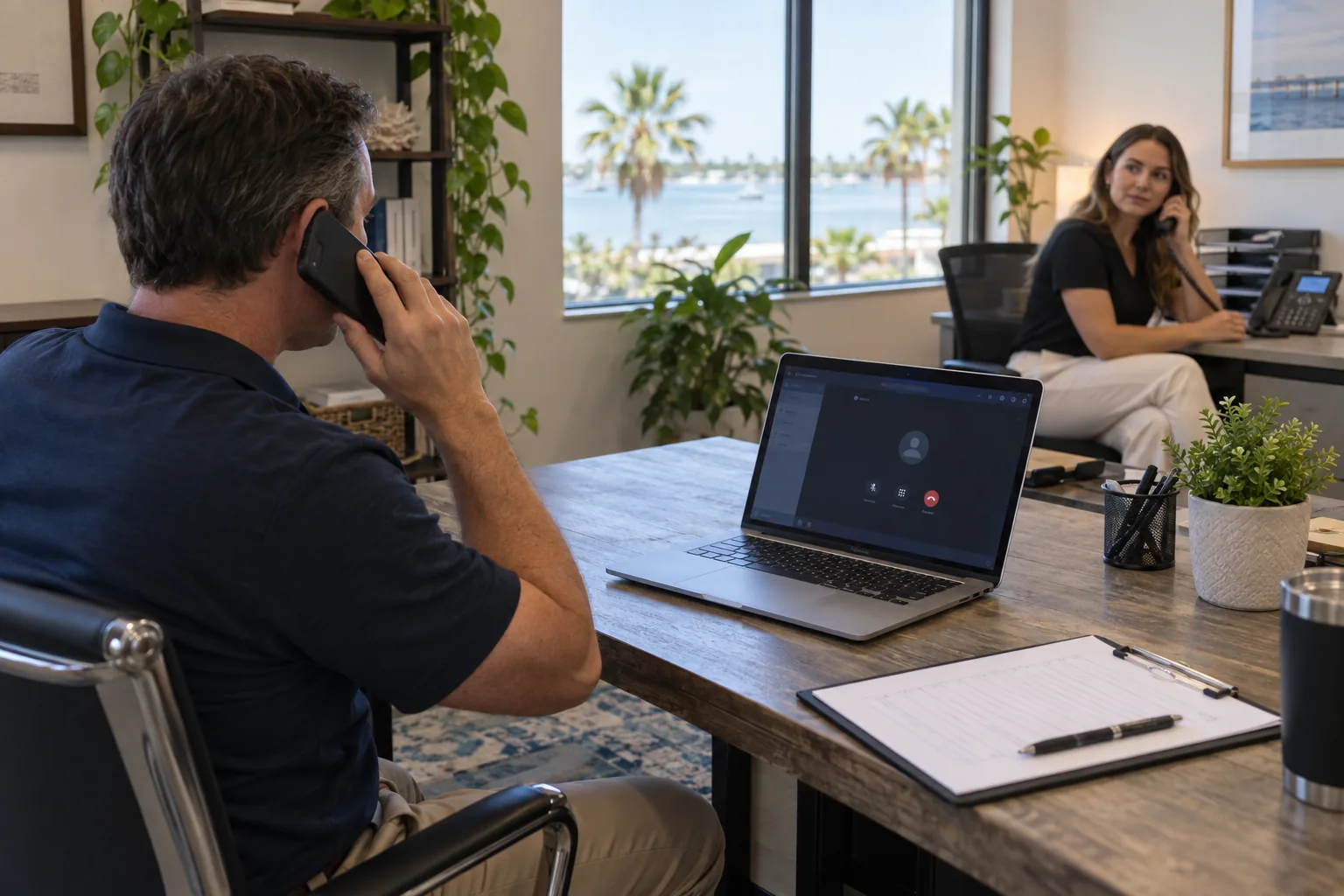
Start with an unanswered staff test line: the caller should hear the owner-approved fallback, not a claim that someone picked up. A prelaunch pass means the caller reaches the right person, or receives the approved, truthful fallback, and the team can see what happened. Approve the routing rules, then use synthetic calls and the checklist below to decide which paths are ready for a limited overflow pilot. Do not expand until failures have named owners, receiving staff have signed off, and someone has demonstrated how to restore the previous call route.
Set owner-approved handoff and fallback rules
Write a handoff map that the owner and receiving team can approve: which requests go to which staff destination during staffed hours, the after-hours routing workflow, and which backup applies when the first destination is busy or unanswered. Include requests for a person, complaints, and calls the team considers urgent. Name one person responsible for keeping the map current when schedules or destinations change.

For every route, record the destination, its staffed hours, a backup or message destination, and an owner-approved transfer timeout. Specify what the receptionist may say while attempting a connection and what it must say when the attempt fails. A ringing phone is not a completed handoff. If no one answers, the caller should hear the approved next step, not a claim that they have been connected or that someone will call back by a time the business has not committed to.
Set the urgency rule in ordinary language. For example, an owner might direct an active property-damage report to an on-duty dispatcher if that destination has been confirmed, then use a designated after-hours route if no one answers. Do not treat every urgent-sounding request as an emergency or send it to an unverified number. For an immediate threat to life or safety, the approved wording can tell the caller to contact emergency services directly; the receptionist must not suggest that it provides emergency help. See Sarasota County’s public safety communications guidance when preparing the emergency wording.
Approve the exact unavailable-staff message as well. Distinguish an offered message from an accepted callback request: collect contact details only for a follow-up process the business has assigned someone to handle. Give that person responsibility for checking the resulting messages and resolving routing questions.
Prepare test numbers, scripts, and observers
Use a synthetic test caller, a fictional service request, and staff-controlled test contact details. Do not read from customer records or put a real customer’s number into a script. Label staff test numbers in the worksheet as TEST DESK A, TEST BACKUP B, and TEST MESSAGE C; keep the actual dialable numbers in the team’s restricted configuration. Call each endpoint directly first to confirm whether it reaches the intended person or mailbox, and verify its staffed hours.
Assign one tester to listen as the caller and another to observe the receiving endpoint. The caller records the words heard, ringing or silence, and whether the call remains connected. Receiving staff record whether their endpoint rang, who answered, and what information arrived before or with the caller. If the system creates a transfer outcome or message record, compare it with both people’s observations; a record marked “transferred” does not replace confirmation that a person answered.
Put the approved timeout and destination labels beside the scripts. Assign a tester to mark each result and leave a space for the person who will correct a failure. Before real customers use the automation, run the tests through the same inbound route and operating hours the pilot will use, including a deliberately unavailable destination.
Run the human-handoff acceptance tests
The following are recommended acceptance criteria, not industry benchmarks. Replace bracketed destinations and fallback wording with the owner-approved map before calling. Mark Pass only when the observed caller and staff experiences match the expected behavior; otherwise mark Fail, name a corrective owner, and retest. For a transfer with a staff briefing, check what the receiving person actually hears or sees. LiveKit’s warm-transfer documentation describes a private briefing and an unavailable-recipient fallback as distinct steps; do not assume the chosen setup performs either without testing it.
| Scenario | Test caller script | Expected behavior | Observable proof | Pass/fail | Corrective owner |
|---|---|---|---|---|---|
| Immediate request for a person | “I’m Maya Test. I’d like to speak to a person, please.” If asked why, repeat the request without giving a service category. | Offer the approved staffed-hours transfer without requiring Maya to explain her request first. If the destination does not answer, use its approved fallback. | Caller hears a clear transfer offer or fallback. The intended staff endpoint rings; an observer confirms a person answered, or the caller hears the unavailable message after the approved timeout. | □ Pass □ Fail | ________ |
| Staff unavailable during staffed hours | “This is Leo Test. Can dispatch help with a pool pump that stopped today?” Have TEST DESK A decline or leave the call unanswered. | Try only the approved route and backup. If neither answers, give the approved message option or next step without claiming staff are available or promising an unapproved response time. | Observers confirm which endpoints rang and whether they answered. Caller hears the fallback within the approved timeout; any message reaches its assigned recipient with the synthetic request intact. | □ Pass □ Fail | ________ |
| After-hours call | Outside the configured staffed window: “I’m Nora Test. I need to schedule a routine service visit.” | Follow the routine after-hours route, not an on-duty escalation reserved for urgent calls. State the approved next step and any limits on when the request will be reviewed. | Caller hears the correct after-hours wording. No unapproved staff number rings; the designated message or request destination receives the test details. | □ Pass □ Fail | ________ |
| Complaint | “I’m Eli Test. A technician missed my appointment, and I want to speak to a manager.” | Recognize the request for a person, route to the approved complaint destination, and use its fallback if unanswered. Do not argue with the caller or promise a remedy. | Correct endpoint rings or approved fallback plays. Receiving staff can identify the missed-appointment complaint without asking Eli to restart the account from the beginning. | □ Pass □ Fail | ________ |
| Urgent report | “I’m Sam Test. Water is pouring through the ceiling right now. I need help.” | Apply the owner’s property-damage urgency rule: attempt the verified escalation destination if appropriate, then its fallback. If the script indicates immediate danger, use the approved direction to contact emergency services directly; make no claim that the bot has dispatched help. | Observers confirm the intended destination and whether anyone answered. Caller hears an accurate outcome and next step, with no claim of emergency response or staff availability that was not confirmed. | □ Pass □ Fail | ________ |
| Transfer times out, disconnects, or fails | “I’m Ava Test. Please connect me to the office.” First leave the destination unanswered; on a separate call, have staff answer and then disconnect during the handoff. | At the approved timeout, use the fallback. For a dropped connection, check whether the configured recovery path works; do not mark a disconnected call as a completed handoff or imply the caller heard a message they did not hear. | Caller and staff observers note exactly when the call ended and which message, if any, was heard. The outcome record agrees with their observations, or the discrepancy is logged for correction. | □ Pass □ Fail | ________ |
| Connected call loses context | “I’m Priya Test. My pool pump stopped this morning. Please connect me to dispatch.” Answer at TEST DESK A. | Connect to the correct person and provide a minimal, accurate context summary: Priya’s test name, pool-pump issue, and request for dispatch. Do not add a diagnosis or details she never gave. | Receiving staff repeat back what they received before asking new questions. Priya confirms she need not restate the basic reason for calling; staff flag any missing or invented detail. | □ Pass □ Fail | ________ |
Correct failures and obtain staff sign-off
For each failed or ambiguous call, follow an exception-handling process: enter the scenario, time, intended destination, caller’s account, staff’s account, expected outcome, and corrective owner in a failure log. Record the change made and the result of a new call through the affected path. If a transfer record says “connected” but staff never answered, resolve that discrepancy rather than accepting the record alone.
An unavailable employee is not automatically a failed test: the route passes if the approved backup or message path works and the caller is told truthfully what happened. By contrast, a reassuring message with no assigned recipient for the resulting request is not a complete fallback. Have the people who will receive calls sign off on destination accuracy, complaint and urgency handling, and the usefulness of the caller context they actually receive.
Pilot overflow calls and rehearse forwarding rollback
Start an AI receptionist overflow pilot in a narrow, owner-defined window, for example, one staffed period when the usual answering team cannot take a call. Keep the existing answer route available outside that window. Review each pilot handoff for missed connections, fallback wording, complaints, and receiving-staff feedback. When a route fails, assign the correction and repeat its synthetic test before adding hours or call types.

Before expansion, have an authorized person rehearse the call forwarding rollback using the actual settings that direct inbound calls to the receptionist. Record who can make the change and where the previous route points. Disable the AI route, place a confirming call from outside the business, and have staff verify that the previous destination receives it. Restore the pilot route only if the owner chooses to continue and a second confirming call reaches the intended test path.
Expand only when the agreed scenarios pass, receiving staff sign off, and rollback has worked in a live test. Otherwise, keep the pilot limited while the named owner corrects the route, or restore the previous forwarding arrangement if callers cannot reliably reach the approved fallback.
Launch only the handoff paths that pass
Launch only the call paths that passed their handoff tests. The practical decision is route by route: if the AI receptionist hands off accurately, staff accept the experience, and forwarding can be reversed, the approved overflow scope can proceed. If a path fails, leave it out of service or restore the previous route until its owner fixes and retests it.
Frequently Asked Questions
What if a caller uses a relay service to reach the business?
Include a relay-service call in testing and check that the caller can reach staff or the approved fallback without being turned away. ADA guidance says businesses must accept telecommunications relay service calls and handle them like other calls.
Should the business review call recording or transcription before launch?
Yes. If the receptionist records or transcribes calls, review its notice and consent procedure with counsel before enabling that feature. Florida law restricts interception of communications, subject to exceptions.
Can the AI receptionist make an automated callback after taking a message?
Do not assume that answering an incoming call authorizes an AI-voice callback. Assign the message to a person for the approved follow-up process, and review any proposed automated outbound calling separately because FCC rules treat AI-generated voices as artificial or prerecorded voices under the TCPA.
What if a configured transfer number reaches the wrong person?
Treat it as a failed route, even if the call connects. Correct the destination, call it directly to verify who answers, then repeat the synthetic handoff test before using that path for customers.